Administrative Data Research UK (2023)
“ECHILD: Linking children’s health and education data for england.” Available at:
https://www.adruk.org/our-work/browse-all-projects/echild-linking-childrens-health-and-education-data-for-england-142/.
Benchimol, E.I. et al. (2015) “The REporting of studies Conducted using Observational Routinely-collected health Data (RECORD) statement,” PLoS Med, 12(10), p. e1001885.
Blackburn, R. et al. (2021) “Hospital admissions for stress-related presentations among school-aged adolescents during term time versus holidays in england: Weekly time series and retrospective cross-sectional analysis,” BJPsych Open, 7(6), p. e215.
Blackburn, R. et al. (2022) “COVID-19-related school closures and patterns of hospital admissions with stress-related presentations in secondary school-aged adolescents: Weekly time series,” Br J Psychiatr, 221(5), pp. 655–657.
Clery, A.
et al. (2024)
“Can administrative data be used to research health visiting in england? A completeness assessment of the community services dataset,” International Journal of Population Data Science, 9(1). doi:
10.23889/ijpds.v9i1.2385.
Clinical Practice Research Datalink (2021)
“Clinical practice research datalink (CPRD): Hospital episode statistics (HES) admitted patient care (APC) data dictionary.” Available at:
https://cprd.com/sites/default/files/2022-02/Data_Dictionary_HES_APC.pdf.
CSCDUG (2023)
“The children’s social care data user group (CSCDUG).” Available at:
https://cscdug.co.uk/.
Department for Education (2015)
“The national pupil database user guide.” Available at:
http://doc.ukdataservice.ac.uk/doc/7627/mrdoc/pdf/7627userguide_2015.pdf.
Department for Education (2017)
“Exclusions statistics guide.” Available at:
https://www.gov.uk/government/publications/exclusions-statistics-guide.
Department for Education (2019)
“Unique pupil numbers (UPNs).” Available at:
https://www.gov.uk/government/publications/unique-pupil-numbers.
Department for Education (2022)
“The school census – what you need to know.” Available at:
https://educationhub.blog.gov.uk/2022/10/07/the-school-census-what-you-need-to-know/.
Department for Education (2023a)
“Children in need census: Guide to submitting data.” Available at:
https://www.gov.uk/guidance/children-in-need-census.
Department for Education (2023b)
“Find and explore data in the national pupil database.” Available at:
https://find-npd-data.education.gov.uk/.
Department for Education (2023c)
“Individualised learner record (ILR) technical documents, guidance and requirements.” Available at:
https://guidance.submit-learner-data.service.gov.uk/.
Department for Education (2023d)
“NCCIS management information requirement.” Available at:
https://www.gov.uk/government/publications/nccis-management-information-requirement.
Department for Education (2023e)
“Pupil absence statistics: guide.” Available at:
https://www.gov.uk/government/publications/absence-statistics-guide.
Department for Education (2024a)
“Children looked after return: Guide to submitting data.” Available at:
https://www.gov.uk/guidance/children-looked-after-return-guide-to-submitting-data.
Department for Education (2024b)
“Complete the school census.” Available at:
https://www.gov.uk/guidance/complete-the-school-census.
Department for Education (2024c)
“Early years census.” Available at:
https://www.gov.uk/guidance/complete-the-early-years-census.
Department for Education (2024d)
“Get information about schools.” Available at:
https://get-information-schools.service.gov.uk/.
Department for Education (2024e)
“Statistics: Children in need and child protection.” Available at:
https://www.gov.uk/government/collections/statistics-children-in-need.
Department for Education (2024f)
“Statistics: Looked-after children.” Available at:
https://www.gov.uk/government/collections/statistics-looked-after-children.
ECHILD (2023)
“The ECHILD project.” Available at:
https://www.echild.ac.uk.
Emmott, E.H., Jay, M.A. and Woodman, J. (2019) “Cohort profile: Children in need census (CIN) records of children referred for social care support in england,” BMJ Open, 9(2), p. e023771.
Etoori, D. et al. (2022) “Reductions in hospital care among clinically vulnerable children aged 0–4 years during the COVID-19 pandemic,” Arch Dis Child, 107, p. e29.
Feng, Q.
et al. (2024a)
“Data resource profile: A national linked mother-baby cohort of health, education and social care data in england (ECHILD-MB),” Int J Epidemiol, 53(3). doi:
/10.1093/ije/dyae065.
Feng, Q.
et al. (2024b)
“Data resource profile: ECHILD only-children and siblings (ECHILD-oCSib): A national cohort of linked health, education and social care data on mothers and children in england,” IJPDS, 8(6). doi:
/10.23889/ijpds.v8i6.2392.
Gilbert, R. et al. (2017) “GUILD: GUidance for Information about Linking Data sets,” J Pub Health, 40(1), pp. 191–198.
Harron, K. et al. (2016) “Linking data for mothers and babies in de-identified electronic health data,” PLoS One, 11(10), p. e0164667.
Harron, K. et al. (2017) “A guide to evaluating linkage quality for the analysis of linked data,” Int J Epidemiol, 46, pp. 1699–1710.
Health Data Research (2023a)
“Innovation gateway: Hospital episode statistics accident and emergency (HES a&e).” Available at:
https://web.www.healthdatagateway.org/dataset/101a7d68-1675-4b47-bfac-dde7b7b57877.
Health Data Research (2023b)
“Innovation gateway: Hospital episode statistics admitted patient care (HES APC).” Available at:
https://web.www.healthdatagateway.org/dataset/6599230a-df54-4615-937c-d724d239491f.
Health Data Research (2023c)
“Innovation gateway: Hospital episode statistics critical care (HES CC).” Available at:
https://web.www.healthdatagateway.org/dataset/d0eeba22-bc3f-4c40-be69-a99f916897a2.
Health Data Research (2023d)
“Innovation gateway: Hospital episode statistics outpatients.” Available at:
https://web.www.healthdatagateway.org/dataset/d4362d41-0838-4f41-bba3-c3268312c444.
Health Data Research (2023e)
“Innovation gateway: Maternity services data set (MSDS).” Available at:
https://web.www.healthdatagateway.org/dataset/0681a1e9-3778-4f43-88b3-6540515404b6.
Herbert, A. et al. (2017) “Data resource profile: Hospital episode statistics admitted patient care,” Int J Epidemiol, 46(4), pp. 1093–1093i.
Jay, M.A., Mc Grath-Lone, L. and Gilbert, R. (2019) “Data resource: The national pupil database (NPD),” Int J Pop Data Sci, 4(1), p. 08.
Libuy, N. et al. (2021) “Linking education and hospital data in england: Linkage process and quality,” Int J Pop Data Sci, 6(1), p. 13.
Libuy, N. et al. (2022) “Gestational age at birth, chronic conditions and school outcomes: A population-based data linkage study of children born in england,” Int J Epidemiol, 52(1), pp. 132–143.
Mc Grath-Lone, L., Dearden, L., et al. (2016) “Changes in first entry to out-of-home care from 1992 to 2012 among children in england,” Child Abuse & Neglect, 51, pp. 163–171.
Mc Grath-Lone, L., Harron, K., et al. (2016) “Data resource profile: Children looked after return (CLA),” Int J Epidemiol, 45(3), pp. 716–717f.
Mc Grath-Lone, L., Libuy, N., Harron, K., et al. (2021) “Data resource profile: The education and child health insights from linked data (ECHILD) database,” Int J Epidemiol, 51(1), pp. 17–17f.
Mc Grath-Lone, L., Libuy, N., Etoori, D., et al. (2021) “Ethnic bias in data linkage,” Lancet Digital Health, 3(6), p. e339.
Mc Grath-Lone, L., Etoori, D., et al. (2022) “Changes in adolescents’ planned hospital care during the COVID-19 pandemic: Analysis of linked administrative data,” Arch Dis Chil, 107(10), p. e29.
Mc Grath-Lone, L., Jay, M.A., et al. (2022) “What makes administrative data ‘research-ready’? A systematic review and thematic analysis of published literature,” Int J Pop Data Sci, 7(1), p. 1718.
Morris, H., Lanati, S. and Gilbert, R. (2018) “Challenges of administrative data linkages: Experiences of administrative data research centre for england (ADRC-E) researchers,” Int J Pop Data Sci, 3(2), p. 097.
Nguyen, V.G.
et al. (2022)
“SEN support from the start of school and its impact on unplanned hospital utilisation in children with cleft lip and palate: A demonstration target trial emulation protocol using ECHILD.” Available at:
https://www.medrxiv.org/content/10.1101/2022.04.01.22273280v1.
NHS England (2023k)
“Master person service (MPS).” Available at:
https://digital.nhs.uk/services/demographics/master-person-service.
Playford, C.J. et al. (2016) “Administrative social science data: The challenge of reproducible research,” Big Data & Society, 3, p. doi:10.1177/2053951716684143.
Scourfield, J.
et al. (2019)
“Overview of administrative data on children’s social care in england.” Available at:
https://whatworks-csc.org.uk/wp-content/uploads/WWCSC_Overview_of_administrative_data_Oct_2019.pdf.
University of Bristol (2023)
“National pupil database user group.” Available at:
http://www.bristol.ac.uk/cmpo/npd-user-group/.
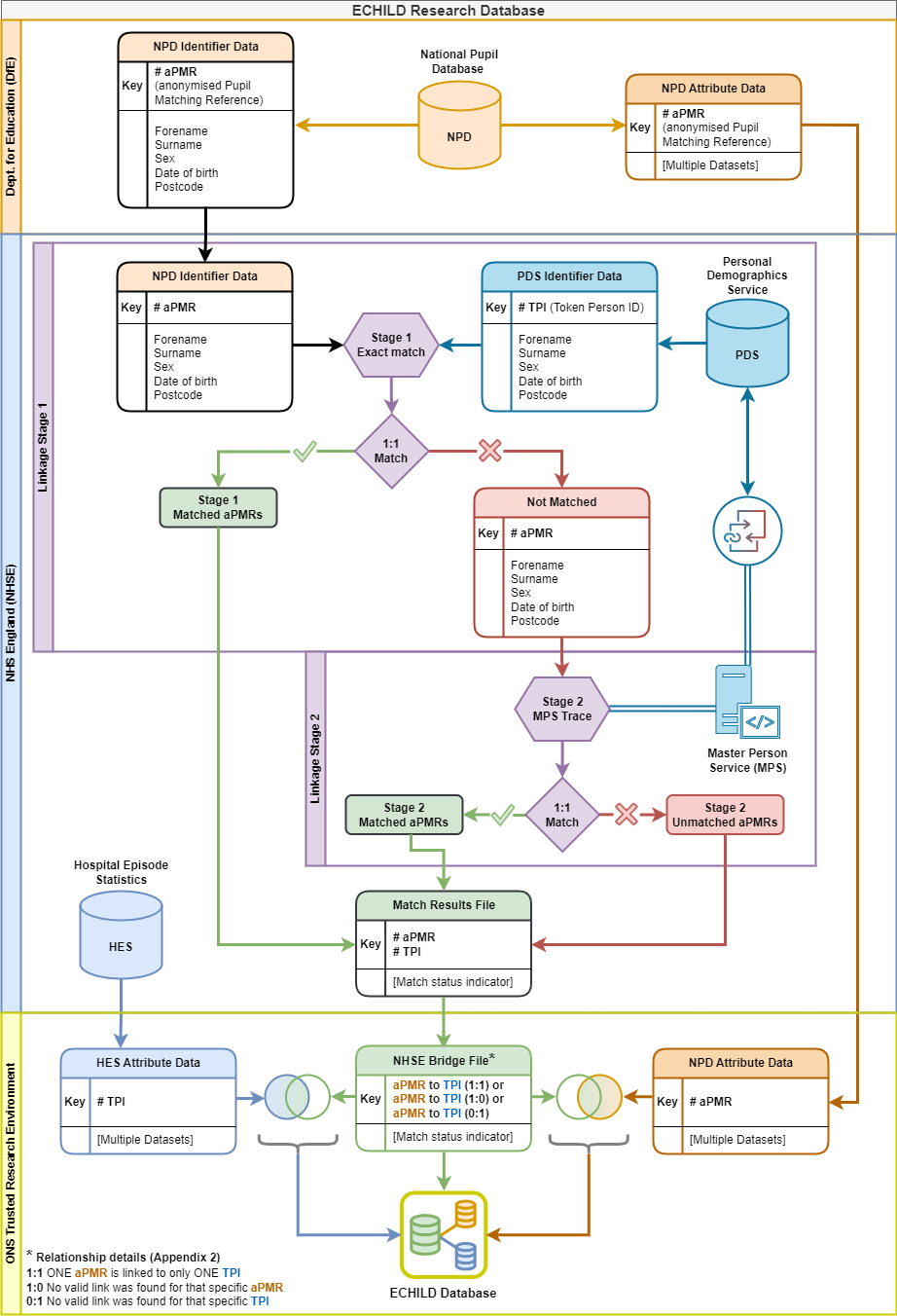 Figure 5: Overview of processes involved in the creation of the ECHILD database.